


Blinds, curtains or shutters? It’s one of those decorating decisions that can completely change both the look and practicality of a room.
While there’s no single option that’s best for every window, each has its strengths. Blinds offer versatility and precise control over light and privacy; curtains bring softness, warmth and colour; while shutters provide excellent privacy and a smart, architectural finish.
So, which is right for your home? Our experts from local Apollo Blinds around the UK explain what to consider before you choose.
When are blinds the best choice?
If you want versatility, blinds are difficult to beat. There’s a huge range available, from simple Roller and Roman blinds to Venetian, Vertical, Pleated, Duette®, Allusion® and Perfect Fit® styles. That means you can choose a blind not just for how it looks, but for what you need it to do.
A bedroom might need a blackout solution, for example, while privacy could be the priority in a street-facing living room. Kitchens and bathrooms bring their own practical considerations, while large windows, bi-fold doors and unusually shaped glazing may need a more specialist solution.
Blinds can also be a particularly good choice where space is limited because many designs sit neatly within or close to the window rather than introducing additional fabric into the room.
And they don’t have to look purely practical. A Roman blind in a beautiful fabric can bring softness and pattern, while a simple Roller blind or Venetian can create a much more streamlined, contemporary look.
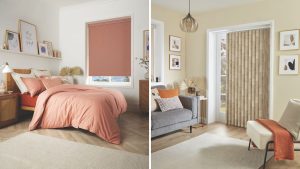
Best for: versatility, smaller spaces, light control and windows where you need a tailored solution.
When are curtains the best choice?
Curtains come into their own when you want to add softness, colour and texture.
Because they frame the window rather than simply covering it, curtains can have a big impact on the overall look of a room. Fabric, pattern, length, fullness and even the heading you choose can all completely change the finished effect.
They work particularly well in living rooms and bedrooms, where you might want to create a warmer, cosier feel. Full-length curtains can also emphasise the height of a room and make a window feel more substantial.
Going made-to-measure gives you much more control over the result. Rather than trying to make standard curtain sizes work for your window, the proportions, fullness, heading and lining can all be selected to suit the individual space.
Curtains can also work brilliantly alongside blinds, rather than being an either/or decision.
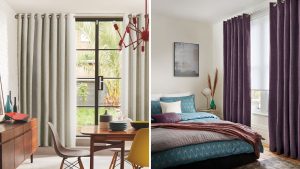
Best for: adding softness, colour, pattern and a more luxurious or layered feel.
When are shutters the best choice?
Shutters are a great option when privacy is high on the wish list, particularly for ground-floor and street-facing rooms.
Adjustable louvres allow you to change the balance between natural light and privacy throughout the day, rather than simply having your window covering completely open or closed.
They also have a very different aesthetic to blinds and curtains. Because shutters are made to fit the window, they become part of the architecture of the room and create a clean, considered finish.
This can work particularly well on bay windows, where made-to-measure shutters can follow the shape of the bay rather than concealing it.
Different configurations can also solve different problems. Full-height shutters cover the whole window, while café-style shutters cover the lower section, giving privacy at street level while leaving the top of the window open to daylight.
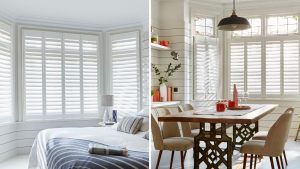
Best for: privacy, bay windows, street-facing rooms and a smart, architectural finish.
Can you combine blinds and curtains?
Absolutely – and sometimes the best answer is to choose more than one window dressing.
Layering blinds and curtains allows each to perform a different job. A blind can provide everyday privacy, glare or light control, while curtains introduce softness, texture and colour.
It can be particularly effective in bedrooms and living rooms, where you might want a practical window treatment during the day but a warmer, more cocooning feel at night.
Layering also gives you more freedom from an interior design perspective. A relatively simple blind can sit behind a stronger curtain fabric, or a patterned blind can become the feature with more understated curtains framing it.
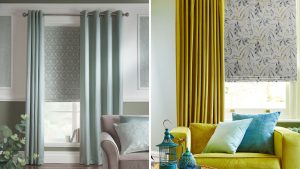
So, which should you choose?
During an Apollo Blinds home design consultation we’ll start by asking ‘what you need the window dressing to do’, rather than simply how you want it to look. This helps us to guide your choice further.
We’ll ask you to consider how much privacy you need, whether controlling sunlight or glare is important, whether you want to darken the room and how frequently you’ll open and close the window covering.
The window itself matters too. A solution that works beautifully on a small bedroom window won’t necessarily be right for a large bay or set of bi-fold doors. By visiting you in your own home during a design consultation, we can see the window or windows you’re dressing, so we can provide the best advice.
And don’t assume that every room in your home needs the same answer.
You might choose shutters for a street-facing bay window, a blackout blind in the bedroom and full-length curtains to soften a living room. The key is finding the right balance between how the window dressing looks and how you need it to perform.
At Apollo Blinds, our local experts can help you compare the options and choose made-to-measure blinds, curtains or shutters to suit your windows, your interior and the way you use your home.
Because the best window dressing isn’t simply the one that looks good – it’s the one that works beautifully for your home too.