


Curtains are firmly back in the interiors conversation for Autumn 2026. Pattern is popular again. Traditional prints are becoming a design feature in contemporary homes. And UK homeowners are looking beyond whether to choose curtains or blinds.
But this isn’t simply another interiors trend.
According to Matt Thomas, interiors expert at Apollo Blinds, the biggest change in 2026 is that we’re asking our window dressings to do more.
“People still want their windows to look beautiful, but they’re thinking more about how a room actually feels to live in,” explains Matt. “And comfort, privacy, light, warmth and personality are all playing a huge part in the decision-making process. I think we’re moving away from just covering a window and back towards really dressing it.”
It’s a shift that’s really reflected in Apollo Blinds’ new collection of made-to-measure curtains and Roman blinds – with traditional and modern patterns, stripes, botanicals and versatile plains in a warm, liveable palette taking centre stage.
So, what’s changing at our windows – and what can the new collection tell us about the way we’re decorating our homes in 2026?
Why are curtains making a comeback in 2026?
Matt believes the curtain comeback isn’t just another interiors trend. It’s actually something much more practical than that: we want our homes to feel comfortable again. And after years of pared-back, minimalist interiors, fabric is increasingly being used to bring softness, texture and a sense of feeling cocooned back into our living spaces.
“Curtains are a brilliant way to really change how a room feels,” says Matt. “They soften the hard lines around windows and bring fabric into the aesthetic on a much bigger scale than a throw or a few cushions, so they can have a huge impact on the overall feel of a space.
“What’s different now is that curtains don’t have to look formal or stuffy. The fabric, heading, fullness and the way you style the rest of the room can make them feel incredibly contemporary. And there are practical benefits too, particularly in the colder months – made-to-measure, fully lined curtains can really add an additional layer of insulation at the window. For me, it’s that combination of how a home feels and how it looks that’s becoming increasingly important.
Why is pattern popular for windows again?
There’s been a real increase in demand for patterned window dressings in 2026 according to Matt, but the patterns don’t necessarily have to be maximalist or shouty.
“We’re seeing homeowners use pattern in a much more controlled way,” he says. “It can be as simple as a single shot of personality in an otherwise quiet room. A few years ago, someone with a mainly neutral room might well have chosen a plain blind or curtain because it felt like the safe option, but we’re seeing much more confidence now. It’s not that people are embracing pattern everywhere – they’re using it in one very considered place. And the window is perfect for that.”
It’s a great tool if you want to bring more character into your interiors without replacing furniture or repainting an entire room.
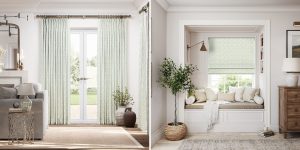
These Inaya Sage curtains and Roman blinds show just how effective a subtle pattern can be. From across the room, the delicate botanical motif reads almost as a soft green texture. Move closer and the detail becomes much more apparent.
Matt calls this type of design a “gateway pattern” for anyone who’s nervous about introducing print. “You don’t have to go from a completely plain room to decorating with huge statement florals,” he says. “A small-scale repeat in a colour you’re comfortable with can be a really easy way in. And because our eyes are naturally drawn to the window, a patterned window dressing can be just enough to give a neutral room a whole new vibe.”
Can traditional curtain fabrics work in a contemporary home?
The juxtaposition between modern and traditional is exactly what makes a room feel interesting. And one of the most noticeable themes in Apollo’s new collection is the smaller-scale, heritage-inspired motifs.
“People sometimes rule out a fabric because they feel it’s too ‘traditional’,” says Matt. “But I think it’s the way you style it that really determines how it feels – a heritage-style print paired with dark metal accents, simple furniture and contemporary lighting looks completely different to how it might appear in a period home, for example.
“That tension between old and new is often what stops a room feeling as though everything was bought at the same time. For me, homes feel more eclectic when there’s a good mix.”
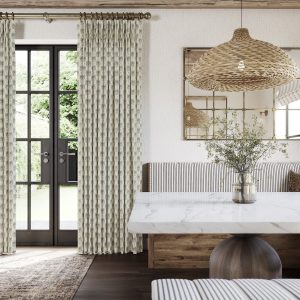
The repeat pattern on this Jaya fabric feels quite traditional, but used as curtains alongside black-framed doors, contemporary furniture and natural textures, it feels much fresher and more modern than you might expect.
Are stripes still in style?
Stripes have been an interiors staple for centuries, but in 2026 they’re more versatile than ever before.
“Stripes are one of those rare patterns that can act like a bit like a neutral,” says Matt. “And they don’t have to be bold deckchair stripes if that’s not your thing. A fine linear design is almost like adding another texture to the room – the finer the stripe, the less your eye reads it as a bold print. It’s a really useful middle ground if you want a change from plain window dressings but don’t want to commit to a floral or large-scale pattern.
“Vertical lines also draw the eye upwards so, on full-length curtains, they emphasise the height of the window and the room.”
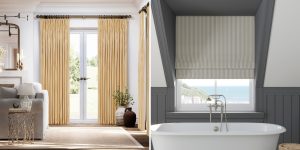
This Ischia fabric really shows the versatility of stripes. The fine stripe in these warm ginger curtains adds colour and warmth to a neutral scheme without feeling overwhelming. On the Ebony Roman blind, the same linear pattern feels much sharper and more architectural.
What curtain and blind colours are trending for Autumn 2026?
Autumn interior décor traditionally brings rich seasonal shades like deep burgundy, dark green, burnt orange, terracotta and rust. But you don’t always have to go for dark colours to create a cosy home.
“The most interesting thing for me about colour this autumn is that we’re seeing warmth,” explains Matt. “Our new collection is packed with soft sage, olive and willow greens, ochre, cocoa, indigo, ginger and warm neutrals. They’re still colours that take their cues from nature – but they’re much easier to live with beyond one season. These shades can all make a space feel cosy and cocooning but they don’t impact the sense of light. And that’s really useful in the UK, when Autumn brings shorter, darker days with it.”
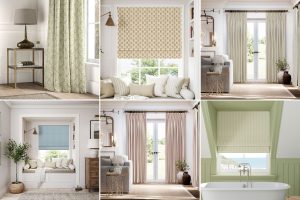
Apollo’s new collection is incredibly versatile – the fabrics will work well throughout the year, with cushions, throws and decorative accessories changed seasonally around them.
Matt also answers some more frequently-asked questions about curtains and blinds
Should my curtains, blinds and accessories match?
“In 2026, it’s less about everything being too matchy-matchy and more about creating a cohesive visual thread through the room. While the new collection does mean fabrics can be coordinated across made-to-measure curtains, Roman blinds and cushions, I wouldn’t advise making everything identical. Good coordination is about making different elements feel as though they belong together. So, if your Roman blind contains sage green, for example, you might repeat that colour in a cushion or throw. Or you could use one patterned fabric at the window and pair it with a simple stripe or plain from the same palette elsewhere in the room. It’s an approach that I think works well in larger or open-plan rooms, connecting different areas without making the space feel overly designed.”
Curtains or blinds – or should you have both?
“I’d advise people to focus more on what they want the window to do, and less on what it looks like. My rule is to think about your window at 10am and again at 10pm. In the morning, you might want plenty of natural light but need to reduce glare, whereas in the evening your priorities might be privacy, darkness and a feeling of cosiness.
“Double dressing means your window treatment can successfully meet two completely different sets of needs. A neat Roman blind gives adjustable daytime coverage at the window, while curtains bring softness and another layer when drawn in the evening. And layering is great for adding visual interest. A patterned blind can become the focal point when paired with quieter curtains. Or a decorative curtain fabric can take centre stage with an understated blind beneath. Choose one element to be the hero and the other to support it. You don’t need two things competing for attention.”
What difference does curtain lining actually make?
“Curtain lining definitely does make a difference. It’s one of those details you may not consciously notice when you walk into a room, but you notice the overall effect. It helps a curtain hang and drape beautifully, gives the fabric a more finished appearance and provides another layer between the room and the window.
“For me, it comes back to that shift towards comfort. We’re not only thinking about whether a fabric looks good when the curtains are open. We’re thinking about how the whole room feels when we draw them at the end of the day.”
Does the same pattern look different on curtains and Roman blinds?
“The same design can sometimes look surprisingly different on a pair of curtains than it does on a blind, so I think it’s something to consider before you fall in love with a particular fabric. A Roman blind, for example, is a relatively flat piece of fabric, so you essentially see much more of the repeat pattern. On curtains, the folds, movement and shadow tend to break up the pattern, giving a much softer overall effect. Sometimes, it’s not as simple as whether you like the fabric – it’s taking into account how that pattern will perform on the window dressing you’re choosing.”
Feeling inspired? Apollo’s new made-to-measure curtain and Roman blind collection is available through local Apollo Blinds experts across the UK. Book a free home design visit with your local Apollo Blinds here and we’ll advise you on colours, patterns and coordinating options.